Friday, March 06, 2009

Tonight at CCCKC: Retro-Computing Live!

Tonight, Frogman and I will be giving a talk about Retro Computing as part of Cowtown Computer Congress' Grand Opening events.

The main focus will be tips for getting the most out of old tech, and of course how to determine if your old tech is worth hanging onto. Of course, we'll spend some time talking about the kinds of things that old computers are still relatively good at.

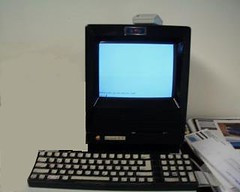
We'll be demonstrating some old hardware that we've amassed that still works just fine. The Jornada 720, The Blackintosh SE/30 (shown left) and others will be present.

I'm still not sure what time our talk will be. Likely after 7pm.

Cowtown Computer Congress Underground Lab
3101 Mercier Suite #404
Kansas City, MO 64111

Tuesday, July 08, 2008

The Ye-Olde Tech Museum

At work, we have a few who remain passionate about retro-computing. Here are some photos from our collective shrine of stuff that still works (and a few things that don't!)

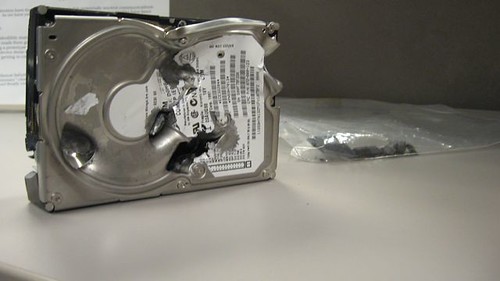
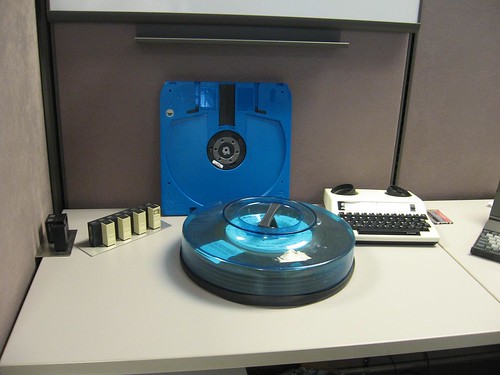
Squarely in the "Does Not Work" pile, a SCSI Drive used for rifle practice: Just try to get data from this:


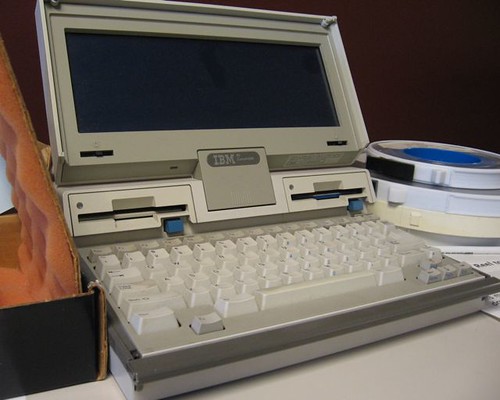
This luggable still tries to boot. Maybe I should bring in some DOS floppies and see if it actually works. No internal hard drive present.


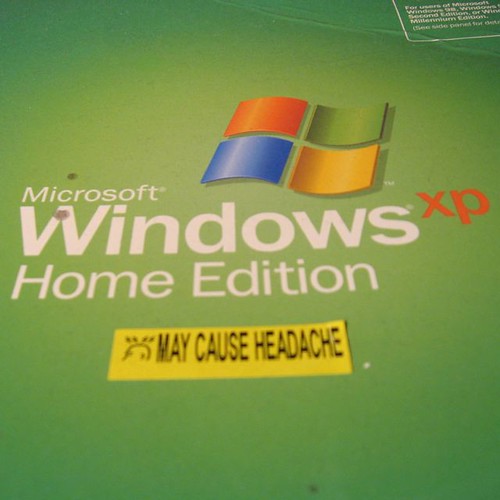
This is how most of us retro-grouch-geeks feel about Windows XP/Vista:


On the right: a working acoustic TDD terminal that (I believe) can be hooked up to a computer to use as a 150/300 baud modem. The various "removable" media present? I don't know that it still works, but I do know we have no drives to test them with.


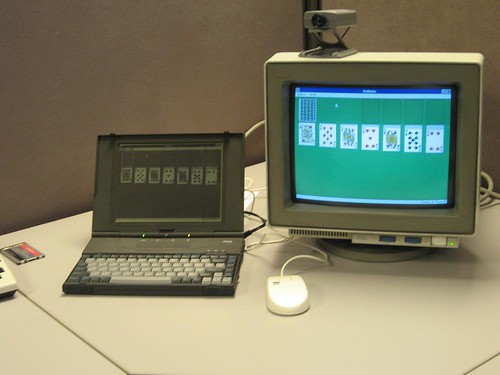
A 386 laptop doing what Windows 3.1 does best: Solitaire!


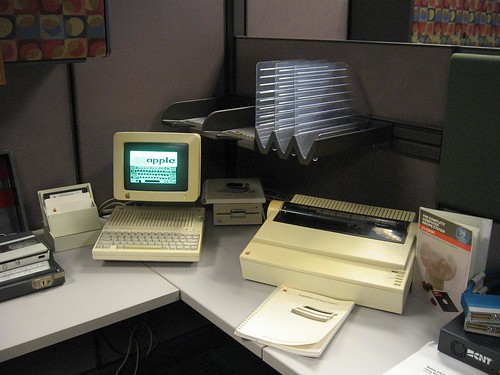
Instant classic: a full-blown Apple //c rig, complete with plenty of apps on 5.25" Disks and a line printer:

Friday, April 04, 2008

jLime Linux on the HP Jornada 720


I picked this up used about a year and a half ago. It's supposed to run Windows H/PC 2000 but after having shelved it for a few months, I figured I could blow it away and start fresh with something new. I'll outline more a bit later.

Saturday, December 30, 2006

Old Vs. New

Manufacturer: Apple Computer
Model: Black MacBook
CPU: Intel Core2 Duo, 2.0GHz
RAM: 1GB, PC2-5300, 667MHz, Dual Channel
HDD: 120GB SATA

I know, I know. Anything but retro. I have to show it off, though. You see, this is the first NEW computer I've personally owned since buying my NEC Versa 550D back in 1995. I usually buy used computers or accept free, used, unwanted components from people who are upgrading.

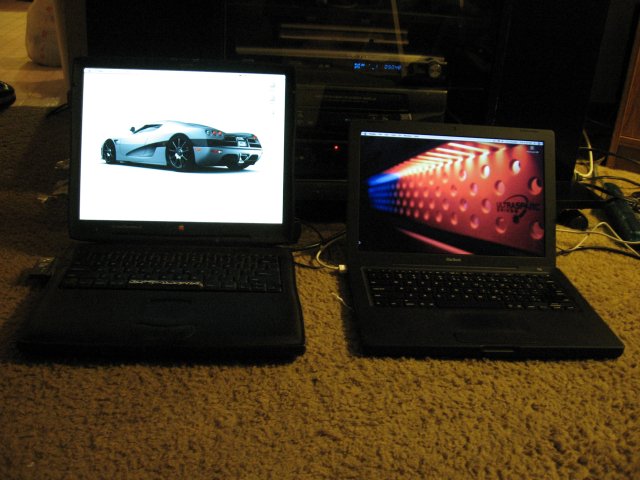
Anyhow, here it sits next to its 8-year-old brother, the G3 PowerBook.

I've had this MacBook for a week now, and I must say that I'm thoroughly impressed. Apple still "has it" for sure. This machine has an excellent fit and finish. It's relatively light weight, pretty thin, but doesn't feel cheap or chinsey at all.

I still plan on using the G3 PowerBook on occation. There's a lot of things it's still useful for, including WarDriving (the MacBook doesn't have a PCMCIA slot for my 200mW card). I'll try to keep the non-retro posts to a minimum, but I had to show it off.

Monday, December 18, 2006

WinTerm 2315 thin clients

Manufacturer: WYSE
Model: WinTerm 2315SE Thin Client
CPU: AMD ELAN
RAM: Unknown
HDD: On-board Flash
Release Date: 1999

I suppose it's time for an update?

I picked up a pair of these for $10 a few weeks ago. Initially, I got them because the guy running the counter at Surplus Exchange thought that they'd probably work with Windows Terminal Server (RDP Protocol) but it turns out that they only play nice with Citrix ICA servers.

Not all hope is lost, however. There is a PCMCIA card slot, and people have reported success booting off of a PCMCIA Flash drive. There are 2 dormant projects out there, one to get NetBSD on this model of WinTerm, the other is a Linux effort. Essentially, the ELAN is a 486 clone without a math co-processor (essentially a 486SX). The board is very tiny, and has VGA, 2 PS/2, 10Base-T, audio, parallel and 2 serial ports. The power supply is 12VDC.

I'm still not sure what I'll use them for if I can get them to boot something useable.

Friday, September 01, 2006

InternetNews: Old PCs a Growing IT Headache

I ran across this article on Internetnews.com today. It talks about the woes of getting rid of end-of-life PCs. As the growing threat of corporate espionage looms, and as data recovery tools become cheaper and more widely available to everyone -- criminals included, IT departments are faced with some tough decisions on what to do with old hardware.


On a side note, most places I've worked at have come to the conclusion that media (hard drives, floppies, backup tapes, old CDs and DVDs, etc) should be destroyed securely by a company like Iron Mountain, and the PC should then be auctioned as surplus without any media. License keys that are affixed to cases are also removed and/or destroyed. The good news with this solution is that people like us can score hardware that's sometimes less than 5 years old, for next to nothing if the stars are aligned correctly.

How to host a website on an old PC

This Page goes into pretty good detail about what all you need to run your own web server using one of your older computers laying around.


Keep in mind, the page that hosts this information IS running on an old PC, and it hit the Digg Front Page. This poor old computer is certainly getting a workout!


Sorry for the lack of updates lately. Not only am I pretty much out of functional 80s- and 90s-era computers of my own to write about, but work is catching up to me right now, and I don't have a lot of free time.

Wednesday, August 23, 2006

Macintosh SE/30


Manufacturer: Apple Computer
Model: Macintosh SE/30
CPU: Motorola 68030, 16MHz
RAM: 64MB
HDD: 2x10GB SCSI
Release Date: January 1989
(Shown: my "Blackintosh" SE/30)

The Mac SE/30 lands itself nicely towards the more powerful end of the compact Mac spectrum. The pre-cursor to the compact Mac was the Apple Lisa, released in 1984. The Lisa was a foreshadowing of Apple's compact design. On the Lisa, Apple placed the drives to the right of the CRT instead of below it. What followed was a form factor that would remain largely unchanged for nearly ten years. Also Introduced in 1984 was the nearly un-usable Macintosh 128k. To the untrained eye, a vintage '84 Mac 128k and a Mac Classic II appear nearly identical, despite the last Classic II shipping out in October of 1993.

Like the SparcStation 5, the Mac SE/30 is another one of those rare gems that absolutely refuses to show its age. It's more portable than many of the "portable" computers of its time. Although it's capable of 1-bit monochrome graphics (black or white, no grays) or 256 grayscale with an expansion card (color with the card and external monitor) there really isn't a point to it.

With the help of Mode32, the SE/30 can operate in 32-bit mode, which makes it a perfect candidate for a UNIX variant. I usually choose NetBSD for 68k-based Macs. As a NetBSD machine with a text-only console, it provides a very robust and tolerable computing experience considering that the first SE/30s rolled off the assembly line almost two decades ago. It's capable of low-CPU tasks such as being a file and print server for a small office or home, providing centralized logging, or even for use as a network administration console when loaded up with pre-compiled tools from the NetBSD package system.

The Mac SE/30 has 8 slots for RAM. You must have Mode32 enabled before upgrading the SE/30 past 8MB of RAM or you might have problems. 4 RAM slots have to be loaded at the same time, so you must use 4 or all 8 slots. You can't use 2 slots or 6 slots.

One thing I did was attach a hard drive power splitter and longer SCSI cable. It's a tight fit, but I was able to squeeze two half-height SCSI drives into the case below the CRT. I also added an Asante NIC. The SE/30 was one of few compact Mac models to include an expansion slot on the back. The added touch of a network card is what makes this machine worthwhile.

In 1998, I took my SE/30 completely apart before painting the case a beautiful gloss black. I also painted the entire keyboard except for the very tops of the keys and sanded the old, sun-yellowed textured mouse and "programmer buttons" to a smooth, light grey finish. I took this machine with me to DefCon that year, and used it in Capture The Flag as my attack platform. I didn't win, but I turned quite a few heads. Most people didn't believe that it was a real SE/30 but thought it must be a 486 and greyscale monitor inside a compact Mac case. I eventually opened the back up so people could see it was the real deal.

I also posted a how-to for teardown of my "Blackintosh" complete with (Crappy) photos on my website some time ago. Enjoy!

Mac SE/30 Teardown